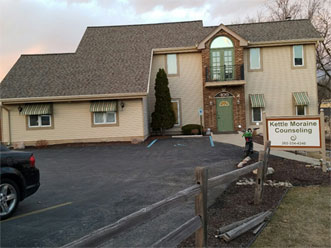
Exciting news from our clinic! We brought on a new therapist, Angela Waldoch, who has a strong background in Art Therapy. I have included her bio in this newsletter. Her email address is angela@kettlemorainecounseling, or you can always call if you would like more Information or to set up an
Attachment Challenged Children Are Biologically Unable to Attach
Children are born with a biological need to connect to people. The first two years are critical! Pay attention to your emotions as you read about Sammy and Tyler when they were four months old.
Sammy woke up from his nap crying. The parent picked him up saying, “Good morning, little one,” comforted him, held him close, looked into his eyes while feeding him, and changed his diaper. Afterwards, they
played. Making eye contact with Sammy, the parent smiled, cooed, stroked Sammy’s cheek, talked softly. Sammy watched and gradually started copying his parent.
In contrast, Tyler woke up from his nap crying. He was ignored for a long time. Eventually, the parent screamed, “Stop your crying!” grabbed Tyler, plopped him on a pillow, shoved a bottle in his mouth, and stormed off. In the background was chaos, swearing, yelling; and the place reeked of alcohol and drugs. The parent came back and sternly shrieked, “Ah, you stink! I’ve got to change a dirty diaper again!” While the parent roughly changed him, Tyler saw a scary grimace on his parent’s face.
Most of us would feel calm, relaxed, and “ahhhh” as we think of Sammy. With consistent positive experiences, Sammy’s brain cells connect to provide permanent hardwiring that at an unconscious level says, “I am safe. I can trust my parents. I am important.” This forms Sammy’s basic, biological expectation for his whole life.
However, with Tyler’s story most of us would feel agitated and “yucky”. With consistent negative experiences, Tyler’s brain cells connect to provide permanent hard-wiring that at an unconscious level says,
“No one will take care of me. I’m bad. This world isn’t safe.” Tyler becomes stressed and at an innate biological level is in survival mode to take care of himself.
Fast forward four years. Sammy wants to please his parents, obeys most of the time, has fun playing with his parents, explores his world, and plays with children. In contrast, Tyler has to control everything! He
emotionally connects with no one, has no desire to please anyone, has no empathy, plays by himself, and mistreats others. His brain is hardwired to be this way. It is not his choice. Tyler feels that to give up control would be to die.
Attachment Therapy
Many parents adopt needy children thinking that with their unconditional love, the child will learn to trust
and change their behavior. They soon realize that traditional parenting techniques do not work with
attachment challenged kids. In fact, the more love given, the more the child may resist. It’s disheartening
to realize that the brain connections established in the first two years of life are permanent. Is there
anything that can be done?
Yes, but only if we meet their needs on an emotional biological level. Intensive narrative attachment
therapy has had very positive results in creating new neurological connections that override the old
fear-based connections (this is called neuro-plasticity). This therapy involves parents and child, once a
week for two hours, for a total of 10 weeks.
For more information, please call Debra S. Graf, LPC. She has been trained in intensive narrative attachment
therapy and can be reached at 262-334-4340 or deb@kettlemorainecounseling.com.
Exciting news from our clinic! We brought on a new therapist, Angela Waldoch, who has a strong background in Art Therapy. I have included her bio in this newsletter. Her email address is angela@kettlemorainecounseling, or you can always call if you would like more Information or to set up an appointment- 262.334.4340. Welcome aboard Angela! Also included in this newsletter is a piece that Deb Graf wrote on what attachment therapy is and can do (one of her specialties!) Enjoy. Devona Marshall
Angela Waldoch
Sometimes talking is simply not enough. Sometimes things are just too difficult to express with words alone. Art and imagery is a universal language that can help express feelings, emotions, and stories when
words fail us.
Angela is an experienced art therapist and holds a Masters in Art Therapy with an emphasis in Counseling from Mount Mary College. She has worked with diverse individuals across the lifespan. Her areas of
interest and specialties range from:
- Children /Adolescent behavioral and emotional issues
- AODA
- Anxiety
- Depression
- Bereavement / Grief / Loss
- Trauma
Angela’s approaches are grounded in her beliefs on life, love, and growth. Everyone has their own life story, complete with interpretations and unique personal experiences. She wants to provide the space where
her clients are able to share their story and make their own narrative. Angela uses strength-based approaches alongside art making and other expressive treatments when necessary, to help her clients
experience their feelings in the present, tell their story, and help make informed decisions about moving forward. We cannot control what has happened to us, but we can make informed choices that better who we are,
and where we would like to go. She would like to help you along the way.
Please call or email to schedule an appointment with Angela.